
CASE STUDY — COMMERCIAL
Assembly House, Kentish Town
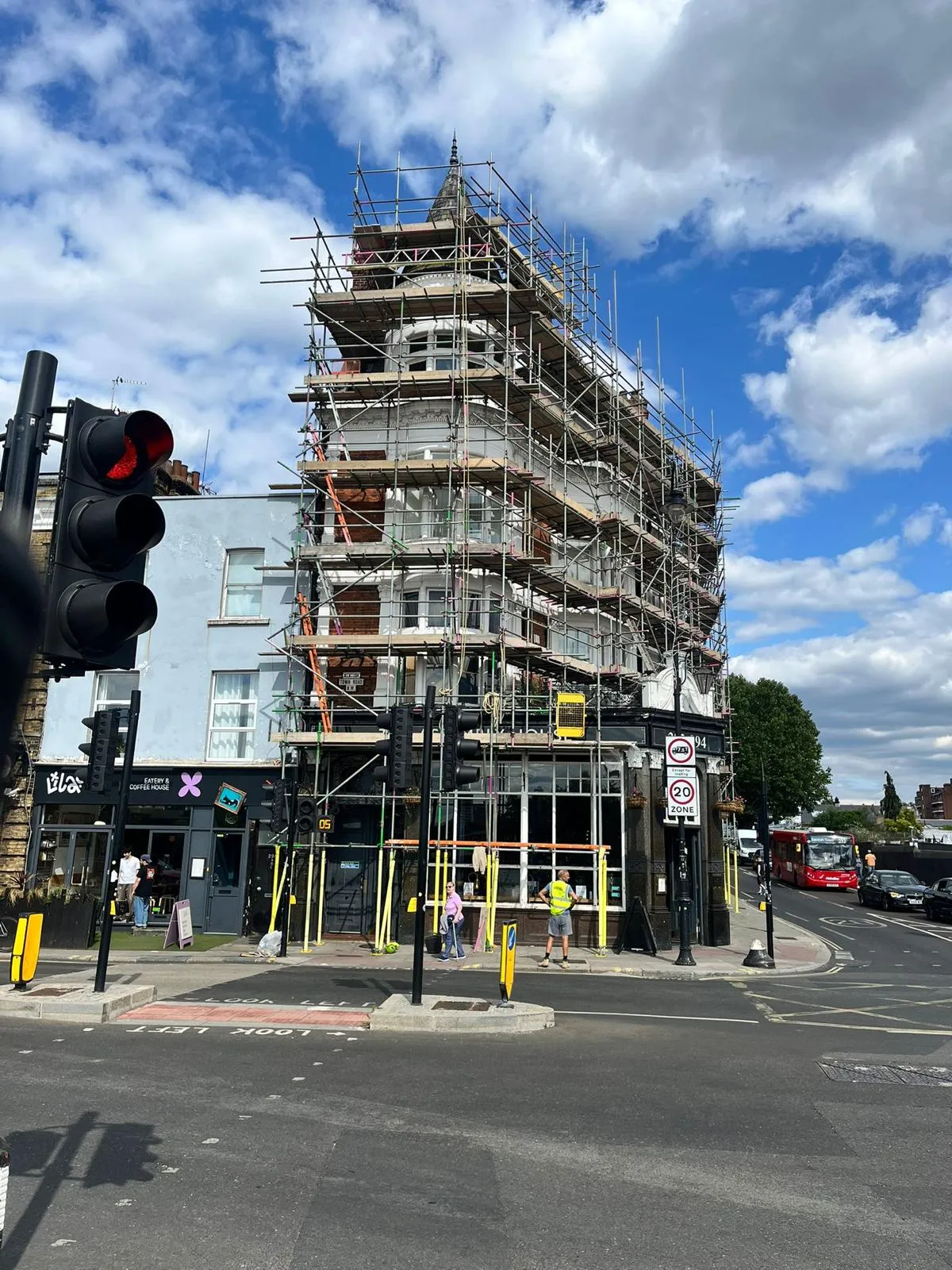
Full wrap scaffold to the turret on a large ornate Victorian corner building — roof restoration works on one of Kentish Town's busiest junctions
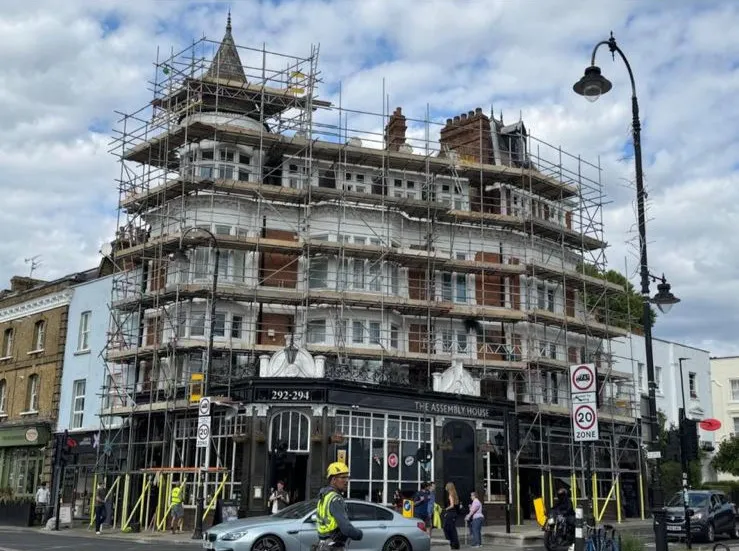
The Assembly House is a large Victorian corner pub building on the junction of Kentish Town Road and Leighton Road in North London — a prominent building on one of the area's busiest junctions, with traffic, buses, pedestrians, and the Kentish Town streetscape on all sides. The building dates from the late Victorian period and its architecture shows it: a decorative stucco facade, ornate parapet with corbelled mouldings running the full length of the roofline, and a distinctive conical slate turret rising above the corner.
Roof restoration works required scaffold access to the full height of the building, including the decorative parapet and the turret at the top. Pinnacle provided the full wrap scaffold for the programme.
The Challenge
A six or seven-storey Victorian corner building on a major London junction is one of the most demanding commercial scaffold environments there is. Every face of the building backs onto a public footway carrying significant pedestrian and vehicle traffic. There is no quiet side, no service road, no protected access route. The scaffold footprint on the pavement requires pavement licence management with Camden Council for each elevation, and the erection itself has to be managed around buses, delivery vehicles, and pedestrians passing at ground level throughout.
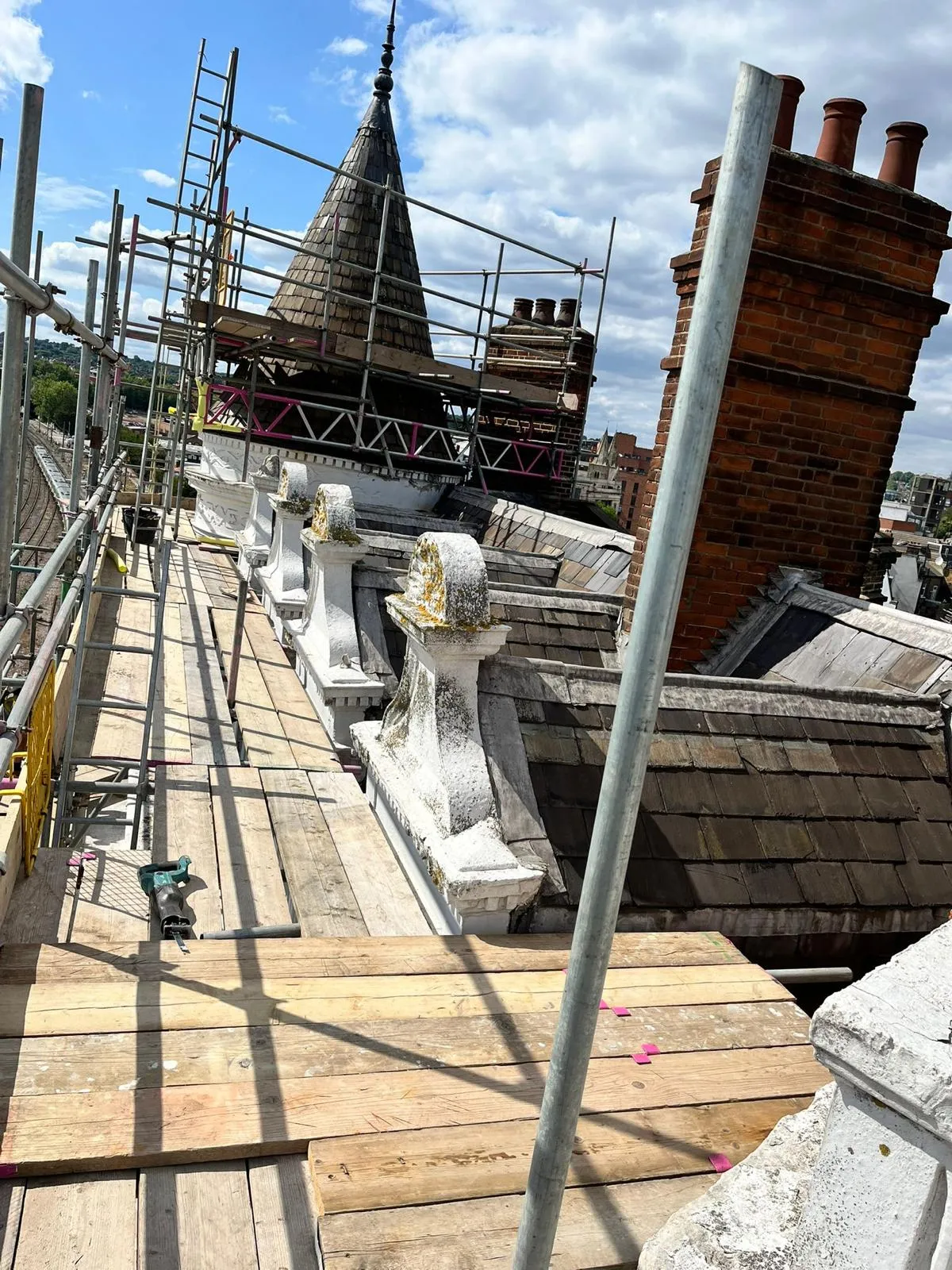
The building's architecture adds a further layer of complexity. The ornate parapet corbels visible in the photographs — decorative Victorian stucco mouldings running along the full roofline — are fragile and irreplaceable. Any scaffold that bears against or contacts these elements causes damage that is expensive and in some cases impossible to reverse. Tie placement on this building required individual assessment at every level, with soft strapping and standoff brackets used wherever the scaffold approached the decorative facade.
The conical turret at the corner is the highest point of the building and the most architecturally significant. Reaching it required the scaffold to rise above the main parapet line and provide working platforms around the turret itself — a structure that does not lend itself to standard scaffold geometry.
Our Approach
Pinnacle erected a full wrap scaffold around all elevations of the Assembly House, rising from pavement level to turret height. Pavement licences were managed with Camden Council for each street elevation before erection began. Highway management at ground level was maintained throughout, with pedestrian routes clearly signed and the pavement kept passable on the junction sides of the building.
Tie placement was assessed individually at each level. Soft strapping and standoff brackets were used at all points where the scaffold approached the decorative stucco parapet, corbelled mouldings, and window surrounds. The scaffold at turret level was designed to provide working access around the conical slate roof for the restoration team.
RAMS documentation and method statements were provided before work began. Every operative held a current CISRS card.
KEY CREDENTIALS
What We Delivered
Large Victorian corner buildings in inner London are among the most demanding commercial scaffold environments we work in. The height, the junction setting, the heritage facade, the pavement management — every element requires individual planning. The Assembly House is exactly the kind of job that demonstrates what Pinnacle can deliver at the upper end of commercial heritage scaffold.
If you manage a heritage commercial building, a prominent corner property, or a large Victorian or Edwardian pub, hotel, or commercial building in London or the South East requiring scaffold access, call us for a free site survey.