
CASE STUDY — COMMERCIAL
Georgian Embassy Building, Central London
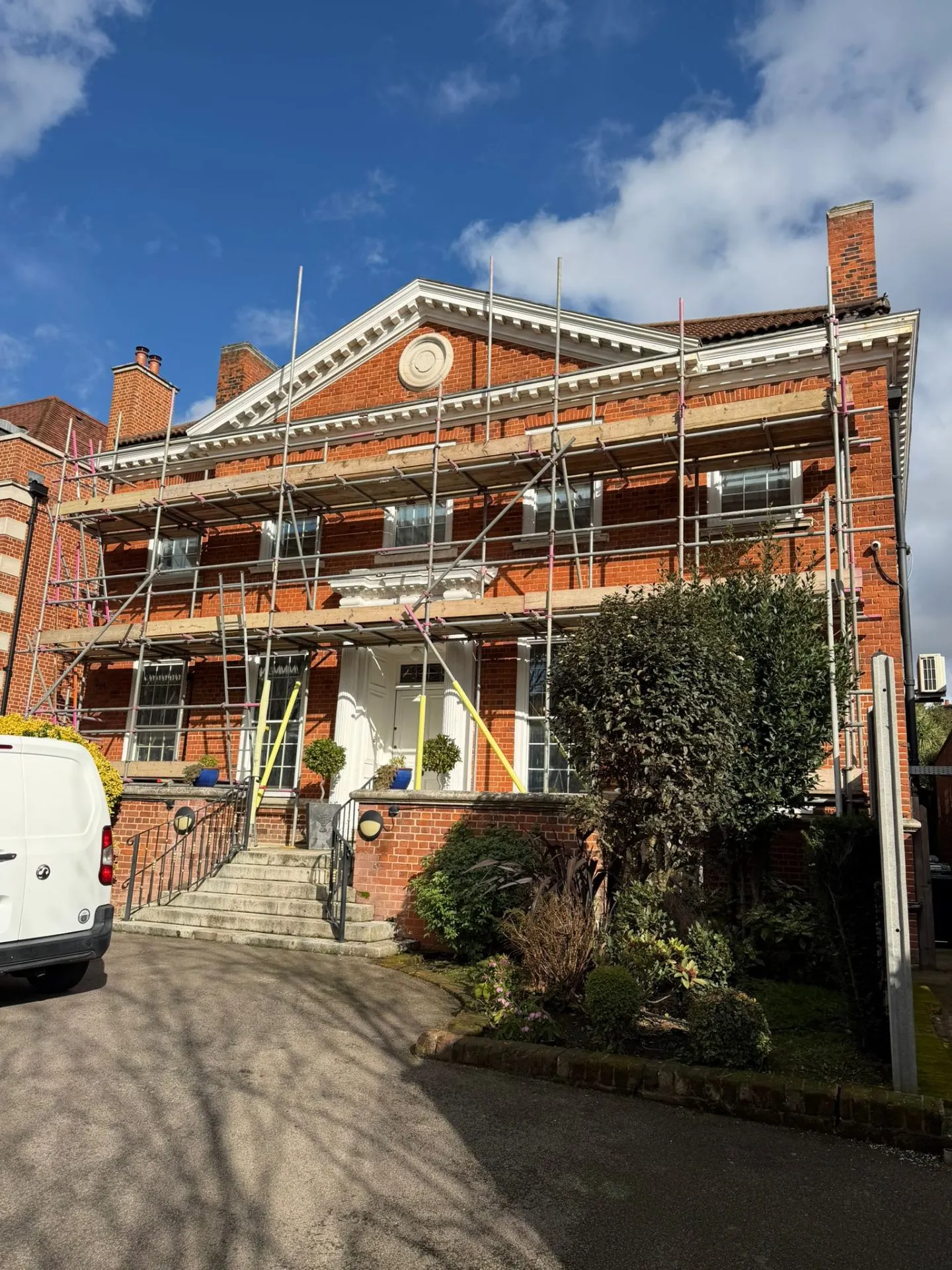
Specialist scaffold for crown moulding and facade repair on a Georgian embassy in central London
Georgian buildings in central London represent some of the most architecturally detailed and diplomatically sensitive environments a scaffolding company can work in. The cornices, crown mouldings, decorative friezes, and period facade elements that define these properties are irreplaceable — and the setting, an active embassy in central London, adds layers of access management, security awareness, and public safety planning that standard commercial scaffold does not require.
This job involved a Georgian embassy building in central London requiring scaffold access for crown moulding and facade repair work. The client has asked that the specific embassy is not named. The building, the challenge, and the approach are all consistent with the most demanding end of Pinnacle's heritage commercial work.
The Challenge
Georgian facade architecture presents specific scaffold challenges. The cornices, mouldings, and decorative friezes sit at or near the parapet level and require working platforms at precisely the right height for stonemasons and plasterers to carry out repairs without overreaching. Platforms that bear against the facade can damage the mouldings themselves — the very detail the scaffold is there to enable work on.
Georgian construction is lime mortar throughout. Wall tie points must be selected with care: penetrating ties in the wrong position can cause cracking to fragile lime plaster or spalling of the stone dressings around windows and door surrounds. Soft strapping and minimal-contact brackets are standard on this type of property.
Working at an embassy in central London adds further complexity. Access to the building and its immediate surroundings requires coordination with the embassy's security team and awareness of the operational requirements of a working diplomatic premises. Public safety management on a busy central London pavement, including pavement licence management with the relevant London borough, is standard on this type of contract. Erection timing must account for the building's operational schedule.
Our Approach
Pinnacle coordinated with the embassy's security and estates team before work began, confirming access protocols, erection timing, and the management of the public realm around the building. The scaffold was designed to provide working platforms at the correct heights for the moulding and cornice repair programme, with tie placement selected to protect the lime mortar joints, window surrounds, and period stonework. Soft strapping was used at all contact points with the building fabric.
The pavement licence was managed with the relevant London borough before erection began. The pedestrian through-route was maintained throughout the contract. On completion, the scaffold was struck cleanly and the facade inspected before handover.
RAMS documentation was provided before work started. Every operative held a current CISRS card.
KEY CREDENTIALS
What We Delivered
Georgian buildings in central London — whether embassy premises, institutional buildings, or period commercial properties — require a scaffold contractor who understands the fabric, the setting, and the people who use the building. We carry out a site survey on every heritage commercial job, design the structure around what is actually there, and coordinate with the building's management team before a single tube goes up.
If you manage a heritage commercial property, an institutional building, or a period premises in central London or the South East requiring specialist scaffold access, call us for a free site survey.