
CASE STUDY — RESIDENTIAL
Georgian Townhouse Repainting, London
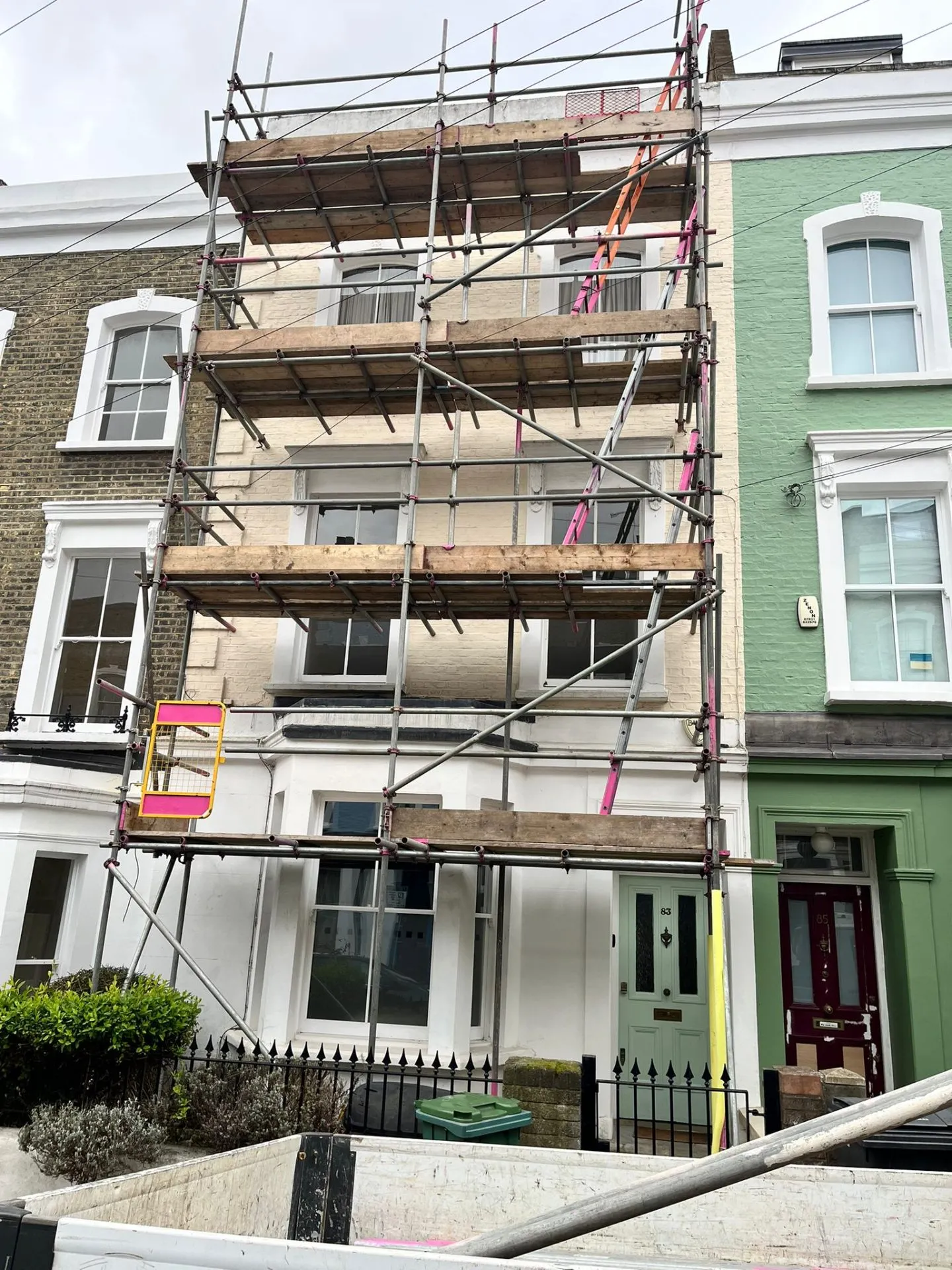
Floating scaffold on a period London townhouse — no penetrating fixings into historic masonry
London's Georgian and Victorian townhouses are among the most architecturally significant residential buildings in the country. They are also, in many cases, Listed — which means that any scaffold erected on them cannot use the standard penetrating wall ties that scaffolding companies rely on for the vast majority of residential jobs.
This job involved a period London townhouse requiring full external repainting. The building's historic masonry facade could not accept penetrating fixings. Pinnacle designed and erected a floating scaffold system that transferred all structural loads to the ground, providing safe working access across the full height of the building without a single fixing going into the historic fabric.
The Challenge
Standard residential scaffold relies on through-wall ties anchored into the building fabric. On a Listed or heritage property, those fixings are not permitted. Any penetration into historic masonry, original render, or period stonework risks damaging irreplaceable material and, on a Listed building, requires Listed Building Consent that is rarely granted for temporary scaffold fixings.
The alternative is a floating scaffold: a self-supporting structure that uses ground-bearing frames and carefully engineered bracing to carry all the loads that would normally be transferred into the wall. Designing a floating scaffold that is safe, stable, and provides full working access at every level of a Georgian or Victorian townhouse requires a different level of technical planning to standard residential scaffold. It also requires operatives who understand why every element of the structure has to go where it goes — and who will not cut corners on a building where cutting corners is not an option.
Our Approach
Pinnacle designed a floating scaffold structure for the full height of the townhouse facade, engineered to transfer all loads to the ground without any wall ties or penetrating fixings into the historic masonry. The structure provided stable, compliant working platforms at every level, giving the painting team full access to the facade from ground to parapet.
The scaffold was erected carefully to avoid damage to the original stonework, render, window surrounds, and any decorative period features on the frontage. Ground protection was in place throughout. The structure was inspected at the required intervals and signed off before the painting programme began. RAMS documentation and method statements were provided before work started. Every operative held a current CISRS card.
KEY CREDENTIALS
What We Delivered
Most scaffolding companies know how to put up a standard residential scaffold. Far fewer know how to design and erect a floating structure on a period London townhouse without touching the building fabric. This is specialist work and we do not approach it the same way we approach a standard roof replacement scaffold.
If you own or manage a Listed building, a period property, or any building where penetrating fixings are not permitted, call us before you call anyone else. We carry out a free site survey and will tell you exactly what is possible before we give you a price.