
What decides the price of a scaffold
Scaffolding is priced on five things: how high it goes, the shape of the building it wraps, what it stands on, whether any of it sits on a pavement or road, and how long it stays up. Two houses of the same size on the same street can be hundreds of pounds apart because of a side return, a conservatory or a sloping garden. Nobody can give you an accurate figure without seeing it.
Written by the Pinnacle Scaffolding team, CISRS accredited scaffolders working across London, Kent, Essex and Surrey. Updated November 2026.
The five things that move the price
Skip to
Typical UK figures, so you have a starting point
These are published market averages for domestic scaffolding across the UK, taken from Checkatrade's 2026 cost guide, which is reviewed by CIOB and RICS member estimators. They are not our prices and they are not a quote. They are here so you can tell whether the number in front of you is in the right postcode.
| Fixed domestic scaffold | Elevations | UK average per month |
|---|---|---|
| Two storey terrace | Two | £800 |
| Two storey semi | Three | £875 |
| Detached bungalow | Four | £1,000 |
| Three storey semi | Three | £1,100 |
| Two storey detached | Four | £1,200 |
| High level chimney scaffold | One, full height | Around £660 per week |
| Bridge over a conservatory | One | Around £650 per week |
| Council pavement licence | Not applicable | Around £140 per month |
Read that table across, not down. The bungalow looks wrong until you notice it is scaffolded on all four sides while the terrace is only done on two. It is the number of elevations and the height together that set the figure, not the height on its own, which is why a single storey building wrapped the whole way round can come out above a two storey one done front and back.
One thing worth knowing if you are in our patch. The same guide puts a four metre tower at around £600 in London against £400 in Colchester and £250 in the north east. London and the south east are the most expensive part of the country for access, and that is labour rates, yard costs and traffic, not anybody taking advantage. If you are comparing a London quote against a figure you read in a national guide, that gap is the reason.
Treat all of it as a sanity check. The rest of this page is what moves your job up or down from those numbers.
Height, and the number of lifts
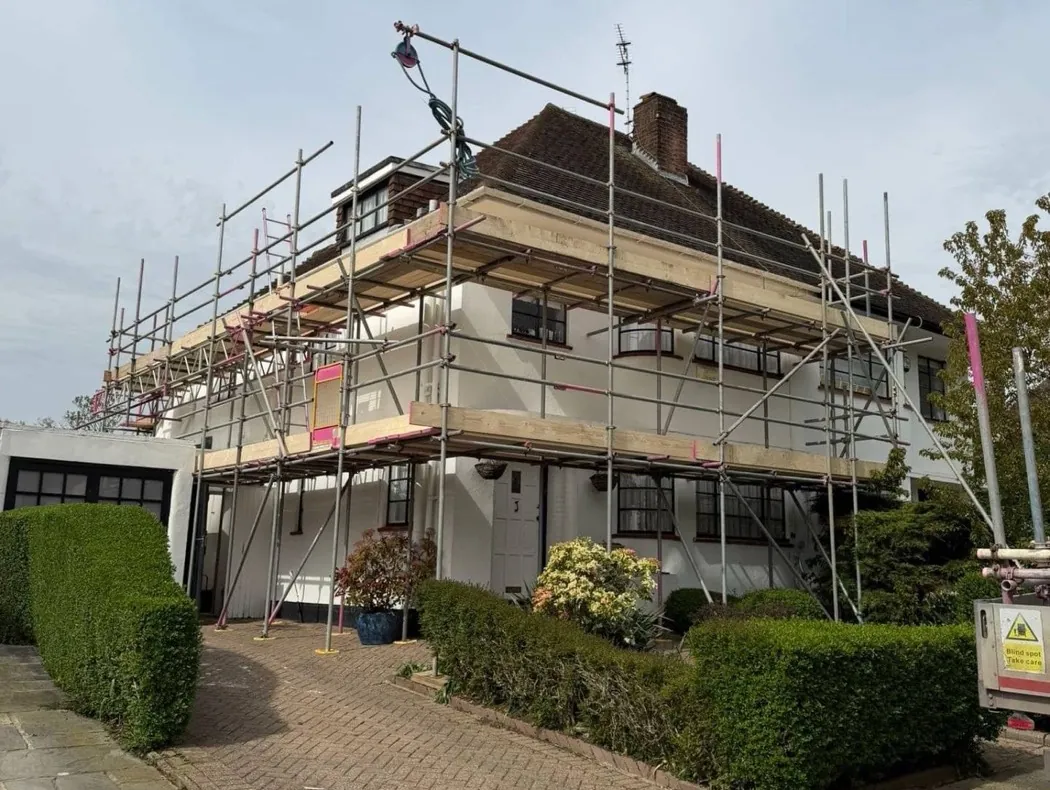
A lift is one working platform. A scaffold to a two storey roof is a different quantity of tube, boards and fittings from one to a three storey roof, and it takes longer to erect and longer to strike. Height is the single biggest driver because it multiplies everything else: more standards, more ledgers, more ties into the building, more boards and more hours.
It is also why chimney work is rarely as cheap as people expect. A chimney stack sits at the highest point of the building, so reaching it means scaffolding the full height of the house and then building above the roof line on top of that.
The shape of the building
This is the one that surprises people. A flat elevation is the cheapest thing a scaffolder can build against. Every time the wall changes direction, the scaffold has to change with it, and every return costs tube and time.
Bay windows, conservatories, lean to extensions, porches, rear additions on a Victorian terrace, dormers and anything the scaffold has to bridge over all add structure. On a period property with original features, the scaffold often has to be designed around what it must not touch, which takes longer to set out than a plain modern elevation.
What it stands on
A scaffold has to bear on something solid. Level, firm ground is straightforward. Soft ground, a sloping garden, a flower bed, a manhole cover, a flat roof, a basement light well or a driveway that has to stay usable all need working around, and some need the load spreading or the scaffold cantilevering out from the building instead.
Access matters too. If every piece of tube has to be carried through the house or down a narrow side alley rather than lifted off a wagon at the front, that is labour, and labour is priced.
Whether it goes on the pavement
If any part of the scaffold sits on a pavement or a road, it needs a licence from the local highway authority under section 169 of the Highways Act 1980. There is a fee, and the application has a processing time. We handle the application as part of the job, but it is worth understanding that the council's lead time sets your start date rather than our availability.
On a terraced street with no front garden this is effectively routine and we factor it into the booking. On a house with its own frontage, keeping the scaffold entirely on your land avoids the fee and the wait altogether, which is worth asking about at the survey.
How long it stays up
Most quotes include a hire period, and the scaffold costs more if it stands beyond it. This is where a cheap looking quote can turn expensive. A lower price with four weeks included is not a better deal than a higher one with eight, if your roofer is going to be six weeks.
The way to control this is the programme, not the price. Work out when the other trades really start and finish before you book, and avoid any arrangement where the scaffold comes down and goes back up. You pay to erect it twice.
Want a real figure rather than a range? The survey is free, it takes about twenty minutes, and you get a price for what is actually there.
How to read a scaffolding quote
Comparing two quotes on the headline figure alone tells you almost nothing. These are the lines worth finding before you choose.
| What to look for | Why it matters |
|---|---|
| Erect and dismantle, split from hire | Tells you what you pay once and what you pay by the week. |
| The included hire period | The number that decides whether a cheap quote stays cheap. |
| Licence fee, in or out | Some quotes exclude it, so the figures are not comparable. |
| Which elevations are covered | Front only, or front and rear, changes everything. |
| Inspections while it is up | Required every seven days. Check they are priced in. |
| Who is actually coming | Directly employed and CISRS carded, or a subcontract gang. |
On that last line, every operative on a Pinnacle job is directly employed and holds a current CISRS card. We do not subcontract, and we are fully insured for public liability. That is worth asking of anyone you are comparing us against.
Get a quote you can actually compare
Ours breaks out erect and dismantle, the included hire period, the licence and the elevations covered, so you can put it next to anyone else's and see which is which.
The jobs that cost more than people expect
Four kinds of job catch people out, and in each case the reason is structural rather than anybody adding a margin.
Chimney work, because the stack is the highest point on the building. Reaching it means scaffolding the full height of the house first and then building a further lift above the roof line, so a job that touches two square metres of brickwork needs a structure to the ridge.
Anything needing a temporary roof, because that is a second structure on top of the first. The scaffold holds people up, the temporary roof keeps weather out, and the scaffold underneath has to be designed to carry it and to resist the wind load it catches.
Rear elevations on Victorian terraces, because the back of a London terrace is rarely one flat wall. A closet wing, an outrigger, a lean to and a lower roof over the kitchen all have to be scaffolded around, and the only way in is through the house or down a side alley.
Blocks of flats, because the work is phased around people living there. A scaffold to a block is not one erection, it is a sequence agreed with the managing agent, often with ground level protection and sometimes with alarms, and that sequence is what you are paying for alongside the tube.
Getting three quotes that are actually comparable
Three quotes only help if all three priced the same job. In practice they often did not, which is why one comes back hundreds below the others and the homeowner assumes the other two are overcharging.
Before you invite anyone out, write down four things and give the same four to each firm. Which elevations need covering. What every trade is going to do up there, not just the first one. How long you expect the works to run. Whether the scaffold can stand on your land or has to go on the pavement.
With that written down, three quotes become three prices for one job instead of three prices for three different interpretations of it. It takes ten minutes and it is the difference between choosing on value and choosing on the lowest number.
Common questions
The honest answer to what scaffolding costs is that the survey is the quote. We will come out, look at the elevations, the ground and the access, tell you whether a licence is needed and what that does to your start date, and price the job properly. There is no charge for that and no obligation afterwards.
If you already know roughly what the job is, there is more detail on the residential scaffolding and commercial scaffolding pages, and the timescales guide covers how quickly we can be on site.
One figure on this page genuinely changes with your postcode, and that is the licence. Each authority sets its own fee and its own terms, so the number differs between south east London, Kent, Essex and Surrey. Each county page says who issues it where you are.
Contact Us
Get Your FREE No Obligation Quote Today
Cost-effective and reliable scaffolding services across London, Kent, Essex & Surrey.