
Do you need scaffolding to replace windows?
Ground floor windows rarely need scaffolding. Upstairs windows usually do, unless the fitter can work entirely from inside the room. Roof windows such as Velux almost always need it, because the work sits in the roof slope. The question worth asking first is not whether a scaffold is needed, it is whether your window company has included access in their quote or expects you to arrange it.
Written by the Pinnacle Scaffolding team, CISRS accredited scaffolders working across London, Kent, Essex and Surrey. Updated November 2026.
Does your job need access?
Skip to
Floor by floor
The honest version is that it depends on the window and the building, not just the height. This is the pattern we see most often.
| Where the window is | Access usually needed |
|---|---|
| Ground floor | Normally none, worked from the ground |
| First floor, fitted from inside | Often none, but confirm with the fitter |
| First floor, handled from outside | Scaffold or tower to that elevation |
| Second floor and above | Scaffold, almost always |
| Roof windows and Velux | Scaffold to eaves, plus roof access above |
| Bay windows with a roof over | Usually scaffold, the bay roof is not a platform |
| Whole house replacement | Scaffold to every elevation being worked |
The question to ask your window company
This is where the confusion comes from. Window quotes split three ways on access, and the quote rarely says which kind it is.
| What the quote does | What it means for you |
|---|---|
| Access included | Nothing to arrange. Check the scaffolder is CISRS carded and insured, because it is still your property. |
| Windows only, access excluded | You book the scaffold and you own the date. Get the survey done before you confirm the fitting day. |
| Silent on access | The risk case. Ask in writing before you sign anything, not on the morning the van arrives. |
Put it in writing before you accept anything. Is access included in this price, and if not, what needs to be in place on the morning you arrive. The answer tells you whether your quote is complete and whether you need a second one from a scaffolder.
Why a ladder is not the answer upstairs
Replacing a window means removing a frame, handling it down, lifting a new one up, setting it level and sealing around it. A sealed double glazed unit filling a 1.2 by 1.2 metre opening is 25 to 30 kilos of glass before the frame goes on it, and that is two handed work. It cannot be done properly from a ladder, where one hand is holding the ladder. Work at height has to be planned and carried out from a safe working platform where it is reasonably practicable to provide one, and on a window replacement it is.
There is a practical reason as well as a safety one. A fitter working from a proper platform can take their time over the seal and the reveal. A fitter balancing on a ladder is rushing, and you will see it in the finish.
Been told you need access and left to arrange it? The survey is free and we work to the fitting date your window company has already given you.
One scaffold, every job on that elevation
Tell us what else is on the list, guttering, fascias, render, painting or the chimney, and we will price a scaffold that covers the lot rather than four separate ones.
Get the rest of the elevation done while it is up
This is the advice that saves people the most money and almost nobody gives it. Once a scaffold is standing against an elevation, every other job on that elevation is cheaper, because the expensive part has already been paid for.
If the windows are being replaced, think about whether the guttering is old, whether the fascias and soffits need doing, whether the render or the pointing wants attention, whether the house needs painting, and whether the chimney is on the list for the next few years. Doing them in one scaffold period rather than four separate ones is the single biggest saving available.
It is worth a conversation at the survey. We will tell you what the scaffold would need to cover for each of those trades, so you can decide before it goes up rather than after it comes down.
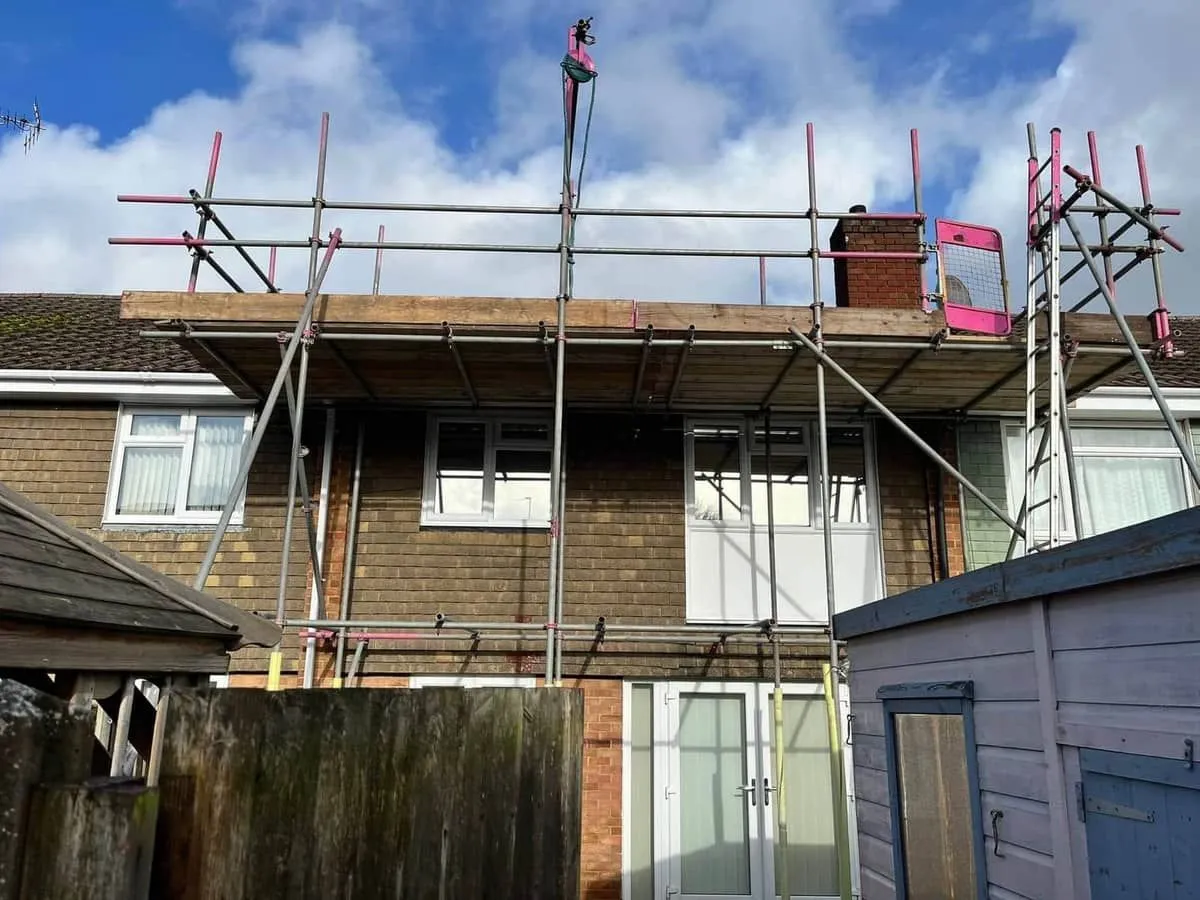
What the scaffold has to do for a window job
A window scaffold is not the same structure as a roof scaffold, and asking for the wrong one costs money. For roof work the top lift sits at eaves level so the roofer can reach the tiles. For window work the platform has to sit just below the cill of each window being changed, so the fitter is working at chest height rather than reaching above their head with a sealed unit.
On a two storey house with first floor windows that is a lift at around two metres, which puts the fitter level with the opening. On a three storey Victorian terrace where second floor sashes are being replaced, the scaffold runs the full height of the front elevation with a lift at each window line. The number of lifts, not the footprint, is what makes a window scaffold bigger or smaller.
Tell your scaffolder which windows are being changed, not just which floors. A front elevation where only the two bedroom windows are being replaced needs less than one where the bay, the landing and the bathroom are all going too.
Five things make a window scaffold quotable in one visit: the number of windows and which elevation each one is on, the floor each sits on, whether any of them are in a bay or a dormer, the fitting date your window company has given you, and whether the scaffold can stand on your own ground or has to go on the pavement. With those five, we can price it at the survey rather than coming back.
Flat owners and leaseholders
If you own a flat rather than a house, the windows are often yours but the outside wall is not. Replacing a window in a block usually needs the freeholder or the managing agent to agree before anything is booked, and they will normally want to see what access is proposed and who is insured for it.
There is a practical consequence as well. A scaffold to one flat on the second floor of a block still has to start at the ground, which means it passes every window underneath yours. Those neighbours need telling, and on some blocks the managing agent will insist on alarmed or anti climb protection at ground level while it stands.
Block work is a regular part of what we do, from penthouse level in Bromley to a housing association regeneration in east London. If an agent or a freeholder has to approve the access, say so at the first call and we will put the information together in the form they will ask for.
Common questions
Window and door replacements at height are a listed part of what we do across London, Kent, Essex and Surrey, and the fitting date is usually set before we are called. Tell us what it is and we will work back from it. Tell us when the windows are booked and we will work back from it.
There is more detail on the residential scaffolding page, the pricing guide explains what moves the figure, and the timescales guide covers how quickly we can be there. You can also check the towns we cover.
What is outside your window changes the job. Sash and casement in the period streets of Kent and Surrey, flats and blocks across south east London, newer stock through much of Essex. The project pages show the access we have built on each.
Contact Us
Get Your FREE No Obligation Quote Today
Cost-effective and reliable scaffolding services across London, Kent, Essex & Surrey.